
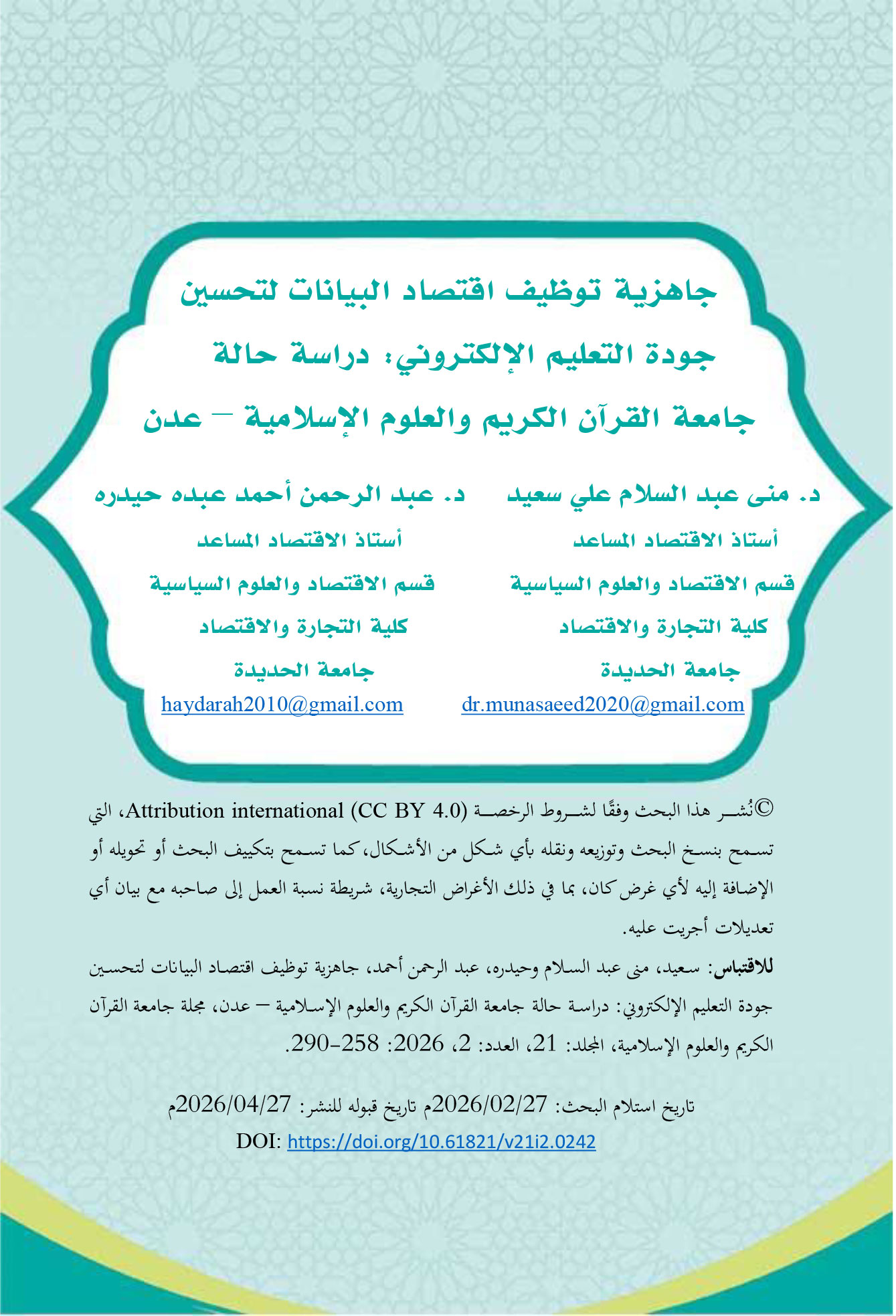
The Readiness of Employing the Data Economy to Improve E-Learning Quality: A Case Study of the University of the Holy Qur'an and Islamic Sciences – Aden
DOI:
https://doi.org/10.61821/v21i2.0242Keywords:
Data economy, learning analytics, e-learning, quality of education, , Yemeni universitiesAbstract
This study examined the readiness to adopt the data economy for enhancing e-learning quality in Yemeni universities, using the University of the Holy Qur’an – Aden as a case study. A descriptive-analytical approach supported by a case study design was employed, based on a conceptual framework linking institutional readiness, learning analytics practices, and e-learning quality, while considering organizational, technical, and ethical constraints.
Data were collected through three questionnaires administered to students, faculty members, and e-learning staff, and analyzed using appropriate descriptive statistical methods. The findings revealed a high level of awareness across all groups regarding the importance of utilizing educational data to improve the learning process. However, this awareness was not matched by effective institutional implementation due to weak organizational structures, the absence of specialized analytics units, limited training, and a lack of clear data governance policies. In addition, learning analytics practices were largely confined to descriptive and diagnostic levels, with limited advancement toward more sophisticated analytical applications.
The study concludes that the primary challenge is not a lack of awareness, but rather an institutional and organizational readiness gap that constrains the transformation of educational data into a strategic asset for improving e-learning quality. Accordingly, the study recommends adopting an integrated institutional framework for the data economy, strengthening governance mechanisms, and building analytical capacities to support sustainable improvements in e-learning quality.
Downloads
Downloads
Published
Issue
Section
License
Copyright (c) 2026 Journal of the University of Holy Quran and Islamic Sciences

This work is licensed under a Creative Commons Attribution 4.0 International License.
©This article is an open access article distributed under the terms and conditions of the Creative Commons Attribution (CC BY) license