
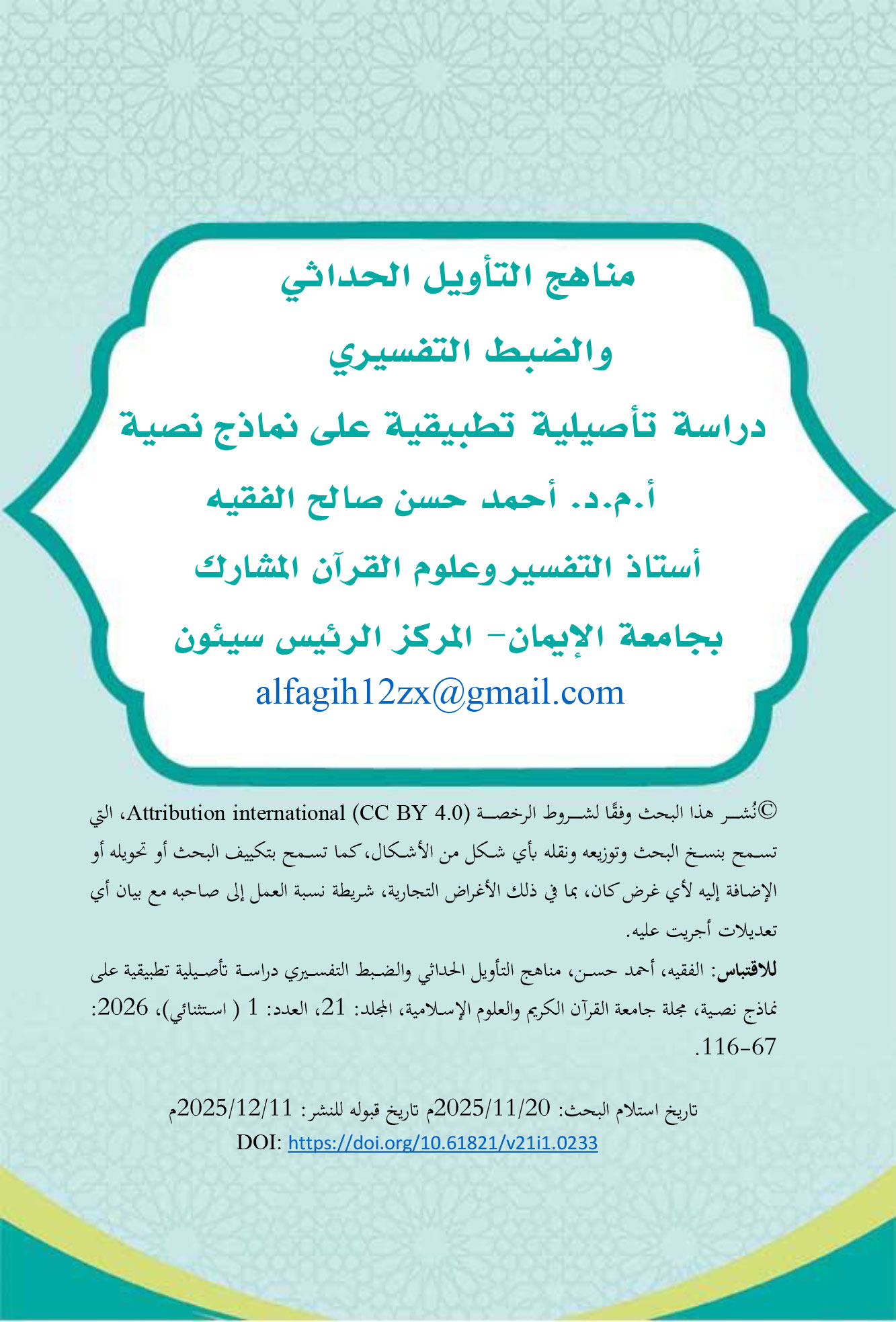
Modernist Hermeneutical Approaches and Exegetical Controls: A Foundational and Applied Study of Textual Models
DOI:
https://doi.org/10.61821/v21i1.0233Keywords:
Methodological Approaches, Modern Hermeneutics, Interpretive DisciplineAbstract
This research aims to study the relationship between modernist hermeneutical projects of the Qur’anic text and the concept of interpretive regulation, which represents the methodological framework for regulating the contemporary understanding of Holy Qur’an.
The research comes in response to the attempts produced by modernist readings to reformulate Qur’anic understanding according to Western philosophical methodologies, without considering the divine nature of the text and its legal purposes. This has created an urgent need to evaluate these methodologies according to the authentic principles of interpretation.
The research addresses the theoretical foundation of the concept of interpretive regulation, its roots in the sciences of exegesis and the principles of jurisprudence, and its methodological parameters. It then presents the modernist hermeneutical approaches by studying their intellectual and philosophical origins, analyzing their methodology in applying interpretation to the Qur’anic text, and discussing their effects on the meaning of the text. The study then applies these concepts to textual examples from Qur’an, aiming to show the effect of the absence of interpretive regulation in distorting meaning and identifying the mechanisms of interpretive deviation.
The research concludes that modernist hermeneutical methodologies do not represent genuine renewal in Qur’anic understanding. Rather, they stem from intellectual backgrounds that contradict the revelatory method in explanation and guidance, as they treat the Qur’anic text as a relative cultural product and not as a fixed divine discourse. On the other hand, the concept of interpretive regulation emerges as a balanced methodology that ensures both the authenticity of understanding and awareness of reality through language, context, and general objectives, in light of the authentic rules and principles of interpretation.
The research relied on the analytical, critical, and comparative method in studying modernist methodologies, and on the descriptive and inductive method in deriving the principles of understanding, with proper documentation from original sources. The main findings of this study are as follows:
- Interpretive regulation is the governing framework for Qur’anic understanding and ensures the balance between stability and renewal.
- Modernist interpretation relies on philosophical backgrounds that strip the text of its sanctity by subjecting it to human whims.
- The deviations of modernist interpretation are manifested in the use of Western methodologies and the abolition of the legal authority in interpreting the text.
- Neglecting interpretive regulation leads to the elimination of the semantic structure of the Qur’anic text and transforms it into open cultural material.
- The disciplined interpretive methodology connects the constants of revelation with the open-minded contemporary reading.
Downloads
Downloads
Published
Issue
Section
License
Copyright (c) 2026 Journal of the University of Holy Quran and Islamic Sciences

This work is licensed under a Creative Commons Attribution 4.0 International License.
©This article is an open access article distributed under the terms and conditions of the Creative Commons Attribution (CC BY) license