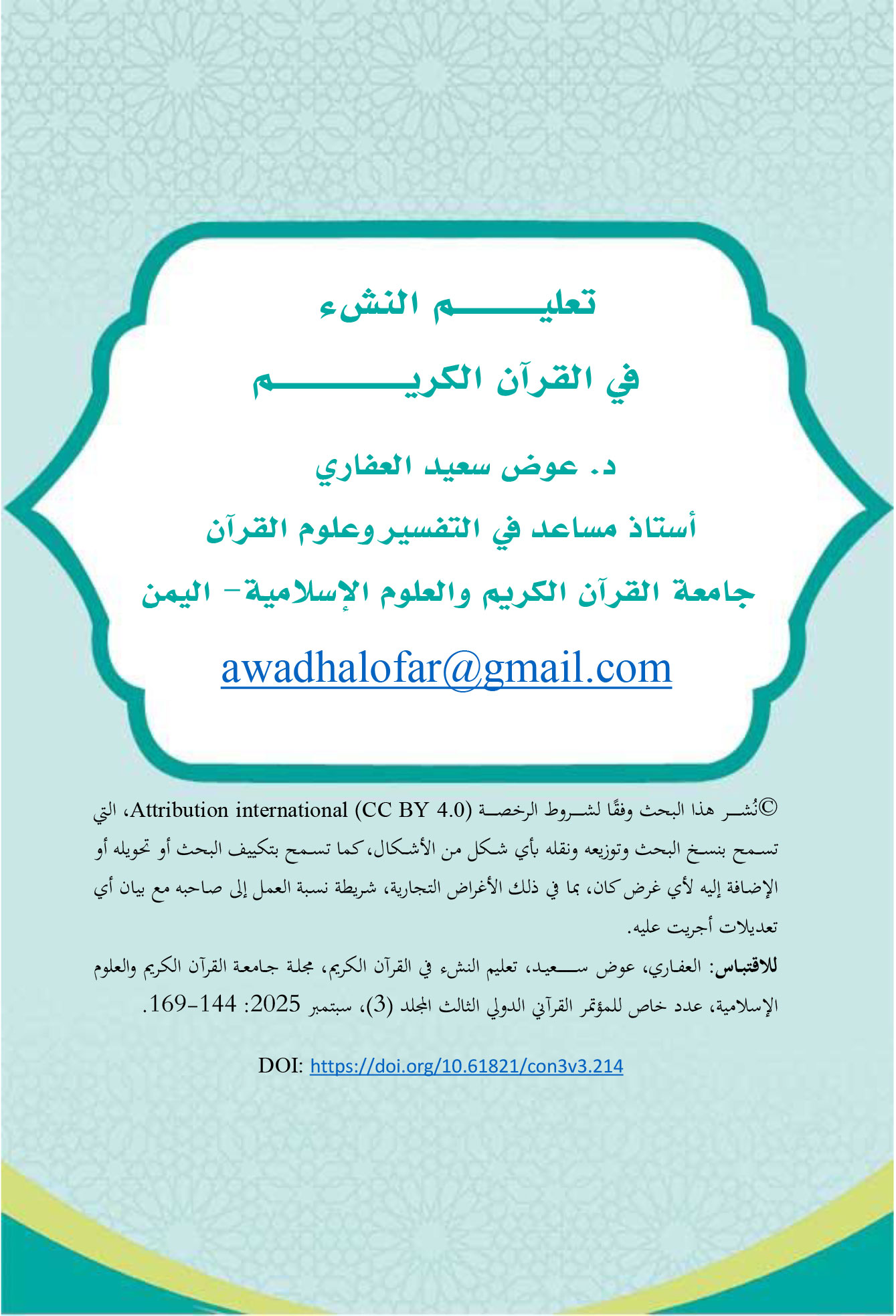
Teaching the Youth in the Holy Qur'an
DOI:
https://doi.org/10.61821/con3v3.214Abstract
The research titled "Teaching the Youth in the Holy Qur'an" aims to highlight the importance of educating the youth as emphasized in the Holy Qur'an through its various texts, which underscore its significance. The study provides examples, interpretations from scholars, and a theoretical foundational perspective on youth education derived from the Holy Qur'an. The importance of this research topic lies in its focus on a critical age group that requires proper education and guidance to build their character in accordance with the Qur'anic principles and directions.
One of the reasons for choosing this topic is the observed neglect in educating this age group properly, leaving them vulnerable to negative influences and misguided ideas that can distort their identity. The study employs descriptive, analytical, and inductive methodologies.
The research is structured to include an introduction, a preface, five sections, and a conclusion. The first section covers early education and instilling faith. The second section discusses education through good example and instilling values, supported by Qur'anic evidence. The third section is dedicated to explaining gradual and compassionate education, love, and dialogue. The fourth section focuses on education through responsibility and continuous guidance. The fifth section aims at education by warning against bad company and ideological deviations.
Among the most prominent findings of the research is the guidance provided by the Holy Qur'an in educating the youth, emphasizing its role as a book of guidance and education. The study underscores the importance and critical nature of youth education during this formative stage. Therefore, the researcher recommends that specialists and research institutions delve deeper into this topic to provide a comprehensive and well-supported vision for youth education in light of the Qur'anic guidance
Downloads
Downloads
Published
Issue
Section
License
Copyright (c) 2025 Journal of the University of Holy Quran and Islamic Sciences

This work is licensed under a Creative Commons Attribution 4.0 International License.
©This article is an open access article distributed under the terms and conditions of the Creative Commons Attribution (CC BY) license